
ESM25
A machine-learning-ready snapshot of the European Engineering Strong-Motion database, mainly recorded in the Euro-Mediterranean and Middle East regions since 1967. Natively compatible with SeisBench.
Description
The ESM25 dataset is a comprehensive, ML-ready compilation of strong-motion recordings from the Engineering Strong-Motion database (ESM). It provides 3C waveforms, manually processed time-histories, and response spectra for nearly 100,000 records mainly across the Euro-Mediterranean and Middle East regions.
The dataset is structured following the format established by INSTANCE (Michelini et al., 2021) and is natively compatible with SeisBench (Woollam et al., 2022), enabling immediate use in machine-learning pipelines for ground-motion prediction, quality-control automation, and site-effect analysis.
Each record has been classified as good or bad quality based on manual review. Good-quality records include both converted-to-physical-units (CV) and manually-processed (MP) waveforms, along with response spectra. Bad-quality records include CV waveforms only. CV contains acceleration only; MP contains acceleration, velocity, and displacement waveforms together with acceleration and displacement response spectra.
Dataset at a glance
- Time span: 1967 – 2026
- Magnitude range: 3 – 7+ (multiple scales: Mw, ML, Ms, mb, Md, EMEC Mw)
- Earthquakes: 6,784
- Total records: 100,249 (64,213 good + 36,036 bad quality)
- 3C waveforms and spectra: 421,314
- Stations: 4,028 (Euro-Mediterranean and Middle East)
- Metadata columns: 597 per record (good-quality) and 110 per record (bad-quality)
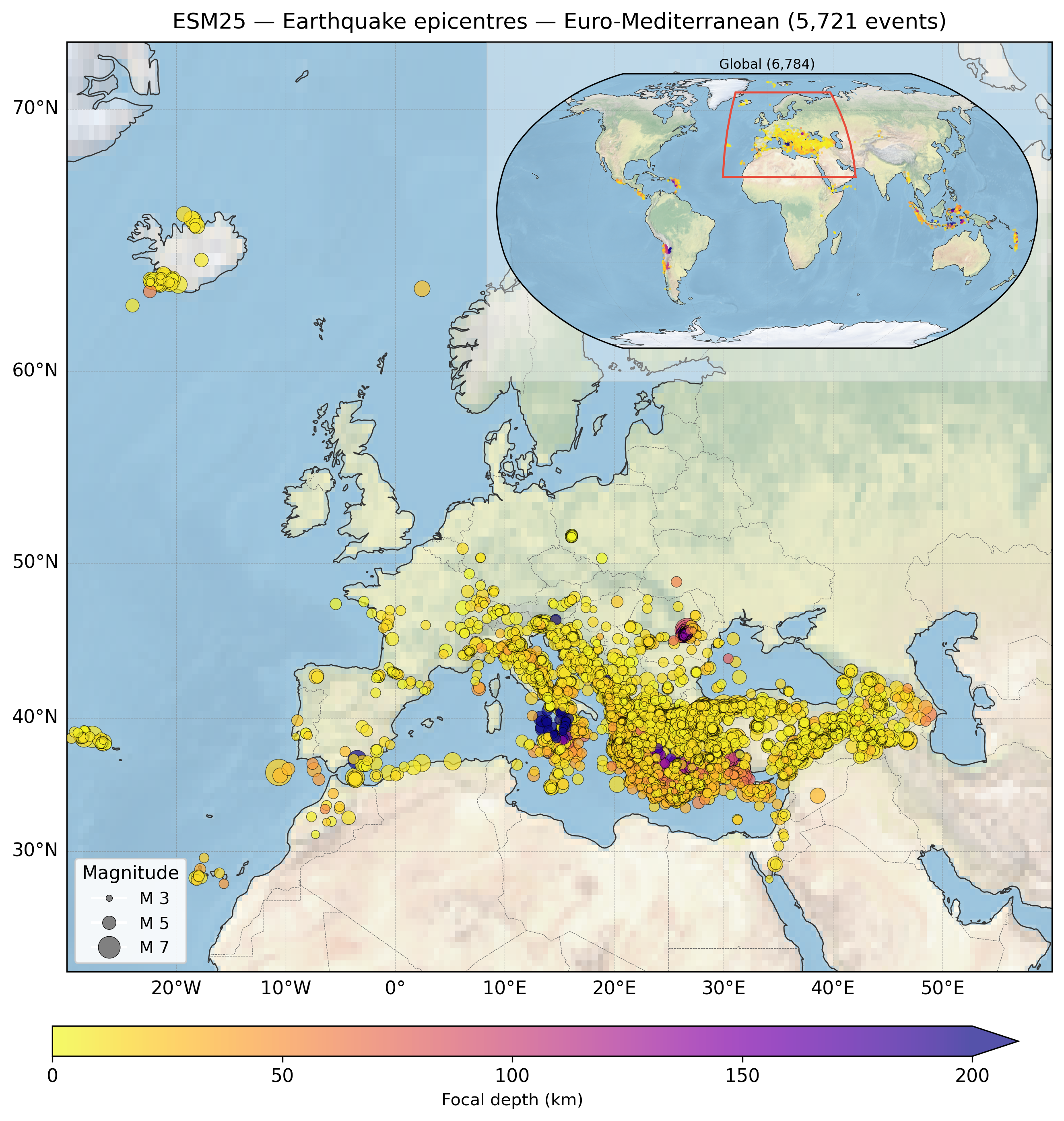 Earthquake epicentres in the ESM25 catalogue. Circle size is proportional to magnitude; colour indicates focal depth.
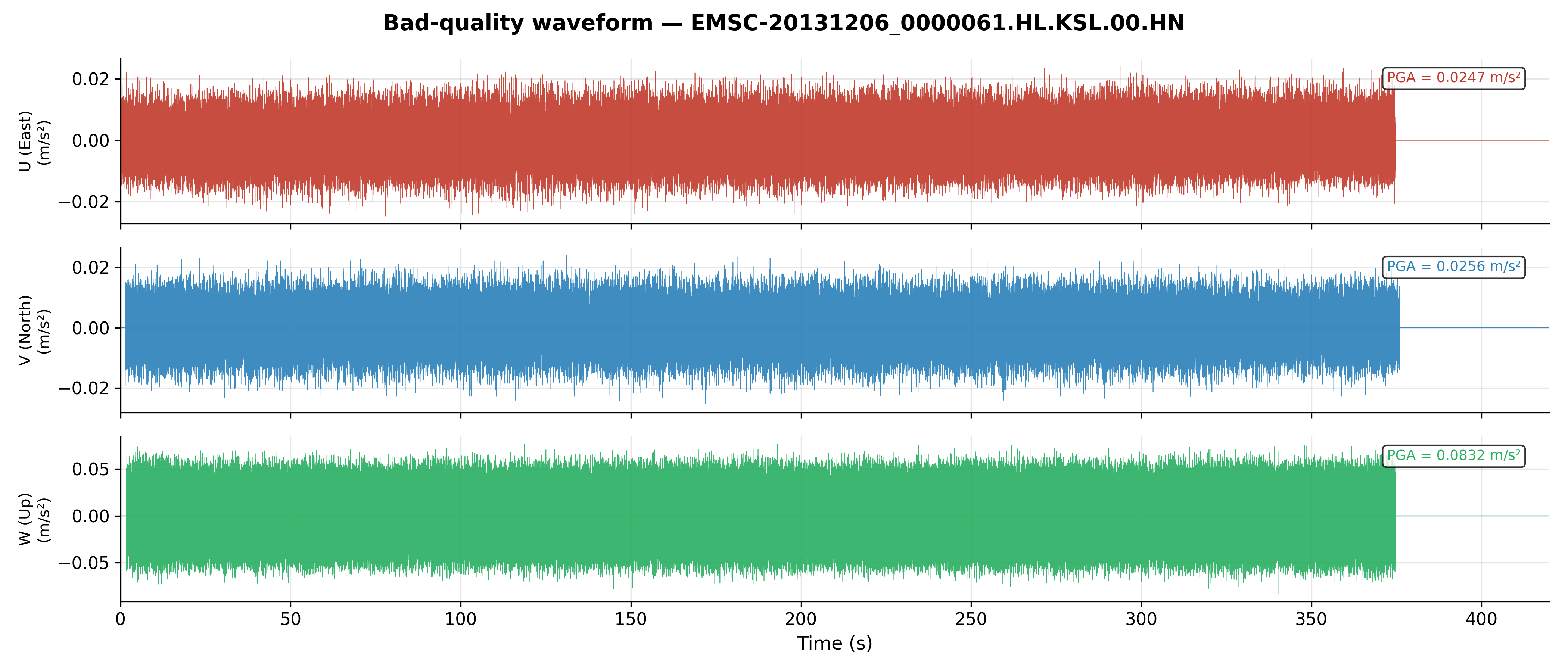 Example of bad-quality waveforms.
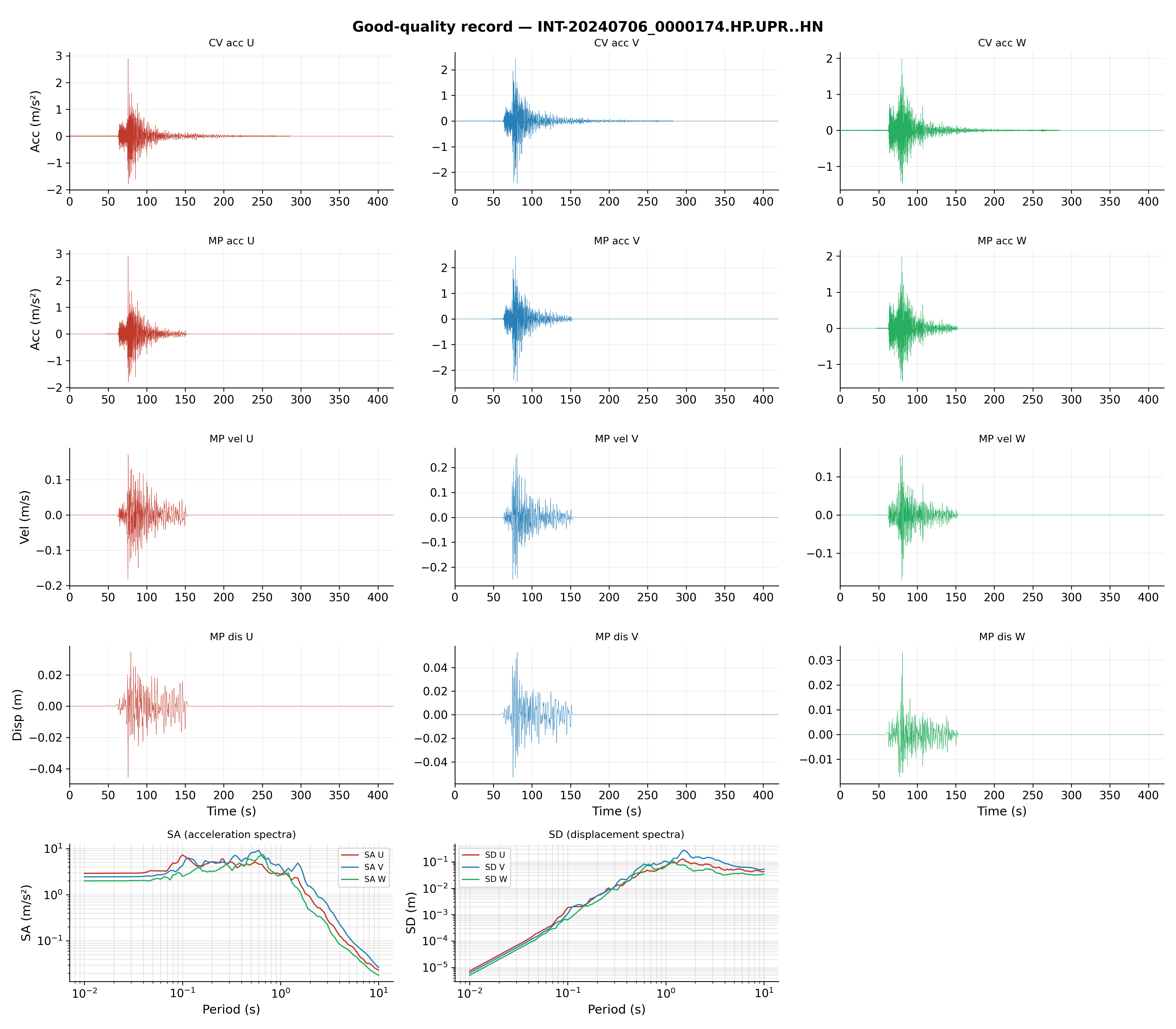 Example of good-quality waveforms. From top to bottom: acc_cv, acc_mp, vel_mp, dis_mp,acceleration and displacement response spectra.
Metadata Structure
ESM25 provides two separate metadata files, one for good-quality (metadata_good.csv) and one for bad-quality (metadata_bad.csv) records. Each row represents an event–station pair. The column names follow a four-prefix naming convention separating information related to earthquake source parameters (source_), recording station properties (station_), source-to-site path metrics (path_), and waveform-level trace (trace_).
- source_ — Earthquake Source:
40 columns • present in both files
Identifies the causative earthquake and characterises its location, magnitude, focal mechanism, and, when available, finite-fault geometry. Identical in both good- and bad-quality files. - station_ — Recording Station:
29 columns • present in both files
Describes the recording station: location, network affiliation, instrument type, and site characterisation through Vs30 measurements and Eurocode 8 soil classification. - path_ — Source-to-Site Path:
7 columns • present in both files
Distance and azimuth metrics between source and recording site. Epicentral and hypocentral distances are available for virtually all records; finite-fault distance metrics (Rjb, Rrup, Rx, Ry0) are populated only when a fault model exists (~12% good, ~4% bad). - trace_ — Waveform Trace:
32 columns • present in both files and additional 487 columns for good-quality records
Record-level waveform metadata and ground-motion parameters. The bad-quality file provides only unprocessed PGA, component orientation, and waveform logistics; the good-quality file adds the full suite of processed intensity measures and response spectra across 6 components (U, V, W, RotD50, RotD100, RotD00).
HDF5 Structure
The dataset is distributed in four HDF5 files, each storing one record per event–station pair indexed by a trace name with the format:
source_esm_id.station_network_code.station_code.station_location_code.station_channel_code.
Waveform files — all waveforms are resampled (or verified) at 200 Hz and zero-padded to a fixed length of 84,000 samples (420 s). Each trace is stored as a 2-D array (components × samples). A data_format group inside each file describes component order, physical units, and padding value.
- waveforms_good_cv.h5 — good-quality CV acceleration: shape (3, 84000), components (acc_cv_u/v/w)
- waveforms_good_mp.h5 — good-quality MP acceleration, velocity, and displacement: shape (9, 84000), components (acc_mp_u/v/w, vel_mp_u/v/w, dis_mp_u/v/w)
- waveforms_bad_cv.h5 — bad-quality CV acceleration: shape (3, 84000), same component layout as good CV
Download
The dataset is distributed as a set of CSV metadata files and HDF5 waveform/spectra files. The ESM25 dataset is split into 6 files to facilitate download. All files are required for full functionality; metadata files are needed to index waveforms in the HDF5 containers.| File | Description | Format | Link |
|---|---|---|---|
| metadata_good | Good-quality records — 598 columns, full source/station/path/trace parameters | CSV | |
| metadata_bad | Bad-quality records — 110 columns, source and station metadata, CV waveform parameters only | CSV | |
| waveforms_good_cv | Good CV acc, 3C, 420 s @ 200 Hz | HDF5 | |
| waveforms_good_mp | Good MP acc/vel/dis, 3C, 420 s @ 200Hz | HDF5 | |
| spectra_all | Response spectra: SA + SD 3C, 105 periods | HDF5 | |
| waveforms_bad_cv | Bad CV acc, 3 C, 420 s @ 200 Hz | HDF5 |
If you use data from ESM25, please cite as:
Cianetti S., Mascandola C., Faenza L., Felicetta C., Russo E., Jozinović D., Münchmeyer J., Luzi L., Michelini A. (2026). ESM25: A Machine-Learning-Ready Snapshot of the European Engineering Strong-Motion Database. Istituto Nazionale di Geofisica e Vulcanologia (INGV). https://doi.org/10.13127/ai/esm25
SeisBench Integration
ESM25 can be loaded directly in SeisBench, enabling immediate use in machine-learning workflows for seismological tasks such as earthquake ground motion prediction, quality control automation, site effect analysis.
GitHub
The ESM25 processing pipeline is documented in a series of Jupyter notebooks available on GitHub: https://github.com/SpinaCianetti/ESM25
Acknowledgments
The ESM25 has been developed within the framework of the ORFEUS community Grants 2025/26
License
 The provided seismic sources information are licensed under the terms of the "Creative Commons Attribution 4.0 International (CC BY 4.0)" License. This means that you are free to share (reproduce, distribute, communicate to the public, publicly display, perform and play this material in any medium and format) and adapt (remix and build upon the material for any purpose, even commercially). The licensor cannot revoke these freedoms as long as you follow the license terms. You must give appropriate credit, provide a link to the license, and indicate if changes were made. You may do so in any reasonable manner, but not in any way that suggests the licensor endorses you or your use. You may not apply legal terms or technological measures that legally restrict others from doing anything the license permits.
This site provides access to waveform data and parametric metadata from the ESM25 dataset, derived from the Engineering Strong-Motion database (ESM). Although all data have been checked by analysts, no warranty, implicit or explicit, is attached. Every risk due to the improper use of data or the use of inaccurate information is assumed by the user.
References
- Luzi L., Puglia R., Russo E., D'Amico M., Felicetta C., Pacor F., Lanzano G., Ceken U., Clinton J., Costa G., Duni L., Farzanegan E., Iliceto V., Irmak T.S., Koutrakis S., Lauciani V., Manakou M., Massa M., Michelini A., Pischiutta M., et al. (2016). The Engineering Strong-Motion Database: A Platform to Access Pan-European Accelerometric Data. Seismological Research Letters, 87(4), 987–997. https://doi.org/10.1785/0220150278
- Michelini A., Cianetti S., Gaviano S., Giunchi C., Jozinović D., Lauciani V. (2021). INSTANCE — The Italian Seismic Dataset for Machine Learning. Seismological Research Letters, 92(5), 3319–3331. https://doi.org/10.1785/0220220070
- Lanzano G., Sgobba S., Luzi L., Puglia R., Pacor F., Felicetta C., D'Amico M., Cotton F., Bindi D. (2018). The pan-European Engineering Strong Motion (ESM) flatfile: compilation criteria and data statistics. Bulletin of Earthquake Engineering. https://doi.org/10.1007/s10518-018-0480-z
- Woollam J., Münchmeyer J., Tilmann F., Rietbrock A., Lange D., Bornstein T., Diehl T., Giunchi C., Haslinger F., Jozinović D., Michelini A., Saul J., Soto H. (2022). SeisBench — A Toolbox for Machine Learning in Seismology. Seismological Research Letters, 93(3), 1695–1709. https://doi.org/10.1785/0220210324
spina.cianetti@ingv.it