
Empirical shaking scenarios
Description
In seismology and earthquake engineering, a shaking scenario is a spatial model that quantifies the distribution and intensity of ground motion over a specific geographical area following a seismic event (historical, recent, or simulated). It integrates seismic source characteristics, wave propagation and attenuation laws, and local geological conditions to provide a continuous map of the expected or observed ground shaking.
This page collects ground shaking scenarios generated using an advanced empirical approach tailored for engineering applications and civil protection planning. The underlying methodology relies on Ground Motion Models (GMMs) calibrated for specific source, propagation, and site effects using empirical corrective factors or non-ergodic approaches, as outlined by Sgobba et al. (2021).
Specifically, the computational framework couples an ad-hoc GMM—adjusted for source kinematics, attenuation properties, and potential rupture directivity effects—with a spatial correlation model that accurately accounts for intra-event variability or systematic site-and-path residuals in the non-ergodic framework.
The resulting median shaking fields for specific events, expressed through various ground motion intensity measures (such as peak ground acceleration and spectral ordinates) along with their associated uncertainties, are available for download below. These datasets can cover historical, instrumentally recorded, and virtual earthquakes.
Products
- NESK-Fucino1915:historical scenario of the horizontal components of ground motion for the Fucino 1915 earthquake described in Sgobba e Pacor (2023).
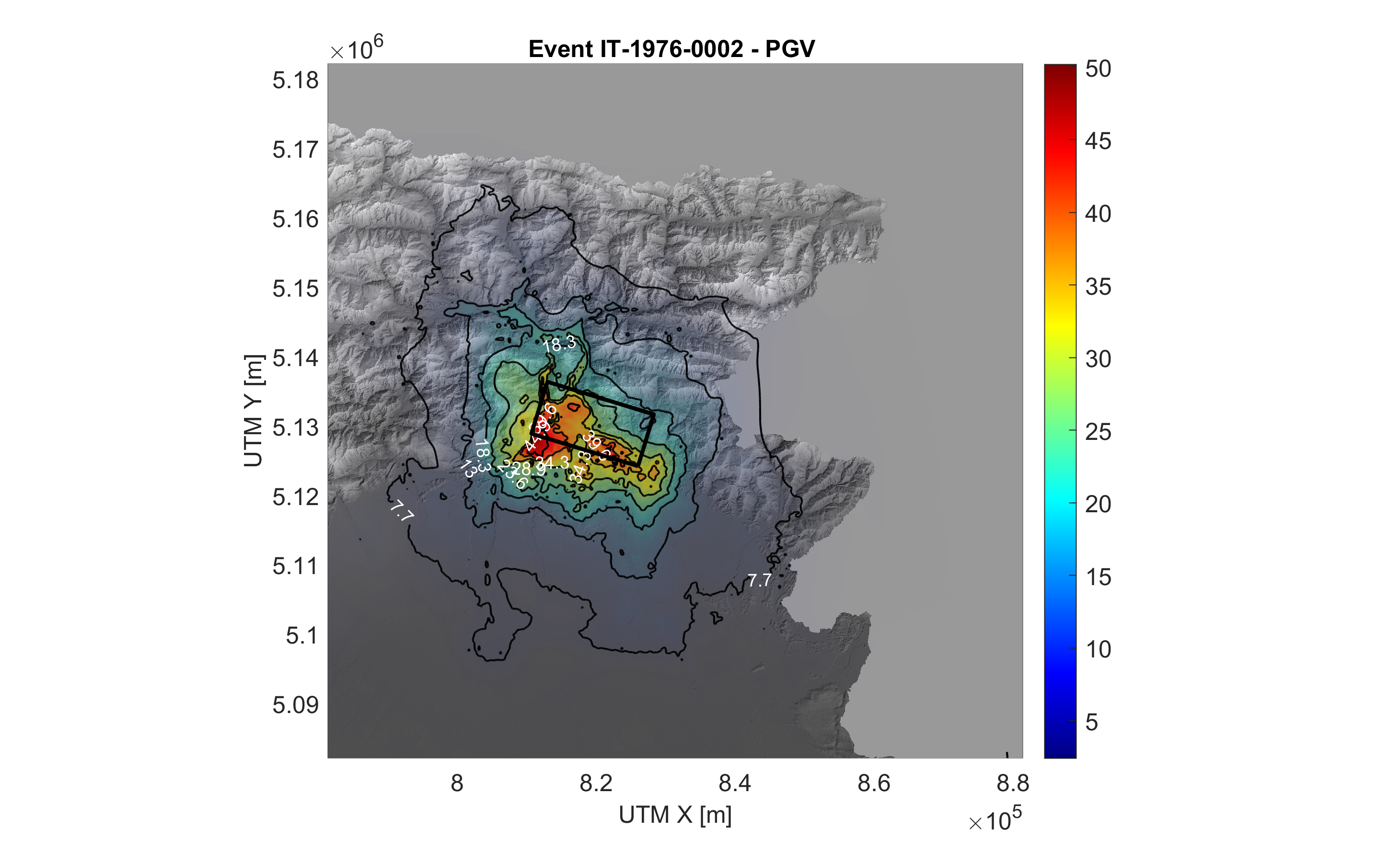
- Friuli 1976: empirical shaking scenario for the 1976 Mw 6.4 Friuli earthquake to map the spatial distribution of engineering Intensity Measures.
References
- Sgobba S., Pacor F. (2023) An application of the NonErgodic ground ShaKing (NESK) approach to an historical earthquake scenario: The case-study of the 1915 Fucino earthquake (central Italy), Soil Dyn. Earth. Eng. 164, 107622, ISSN 0267-7261, https://doi.org/10.1016/j.soildyn.2022.107622
- Sgobba S., Lanzano G., Pacor F. (2021) Empirical nonergodic shaking scenarios based on spatial correlation models: An application to central Italy. Earthquake Engng Struct Dyn. 2021; 50: 60 80.https://doi.org/10.1002/eqe.3362
License
 The NESK-Fucino1915 ground shaking scenarios are licensed under the terms of the "Creative Commons Attribution 4.0 International (CC BY 4.0)" License. This means that you are free to share (reproduce, distribute, communicate to the public, publicly display, perform and play this material in any medium and format) and adapt (remix and build upon the material for any purpose, even commercially). The licensor cannot revoke these freedoms as long as you follow the license terms. You must give appropriate credit, provide a link to the license, and indicate if changes were made. You may do so in any reasonable manner, but not in any way that suggests the licensor endorses you or your use. You may not apply legal terms or technological measures that legally restrict others from doing anything the license permits.
Disclaimer
This site provides access to empirical shaking scenarios for 1915 Fucino and 1976 Mw 6.4 Friuli earthquakes. Although all the parameters have been checked by analysts, no warranty, implicit or explicit is attached to the data. Every risk due to the improper use of data or the use of inaccurate information is assumed by the user.